Removing something from a video and filling the gap back in with plausible background has a name in research: diminished reality, built on video inpainting. Most of that work runs offline, on recorded clips, with a GPU and time to spare. VeBeGe does the narrow, live version of it: erase the people who wander behind you on a video call, on the webcam feed itself, before the call ever sees the frame. This page is for anyone who found us while reading about the models below, and wants to know how the two connect.
The systems people track in this space fall into two groups. One reconstructs missing regions of a finished video beautifully but slowly. The other removes objects from a view as you watch. VeBeGe sits firmly in the second group, aimed at one everyday problem: bystanders in the background of a webcam.
Given a video and a mask of what to remove, rebuild the hidden pixels across every frame so nothing flickers. This is the offline, high-quality track: E2FGVI, DSTT, and ProPainter.
Remove real objects from a live view and fill the space convincingly, fast enough to feel live. This is the track VeBeGe belongs to, alongside research like PixMix and InpaintFusion and browser demos like Disappearing People.
If you have been reading about video inpainting, this is the line of work you have seen. Each one raised the bar on quality; none of them was built to run on a webcam mid-call.
An end-to-end, flow-guided approach to video inpainting. It matters here as lineage: it helped establish that you can propagate a clean, consistent background across frames rather than inpainting each frame alone. Built for recorded clips, not a live feed.
A decoupled spatial-temporal transformer for video inpainting. It sharpened how these models reason about motion over time, the same problem VeBeGe faces when a person moves through the frame, but again as an offline model.
The current strong inpainting family, with better propagation and a transformer core. It is the natural thing to search for when you want quality, and people do ask whether anyone has made it run live. VeBeGe does not use ProPainter, it takes a lighter, real-time-first path, but if you found us looking for "ProPainter real-time," VeBeGe is the shipping answer to the question that search is really asking: can I remove people from my video now, not after.
Closer to what VeBeGe actually does: remove things from a live or interactive view and keep the scene believable. This is the harder, real-time side of the problem, where "good enough, right now" beats "perfect, eventually."
VeBeGe shares the goal and makes a deliberate trade: it solves one framed, well-behaved case, a mostly static room seen by a fixed webcam, so it can run every frame on ordinary hardware with no cloud and no GPU farm.
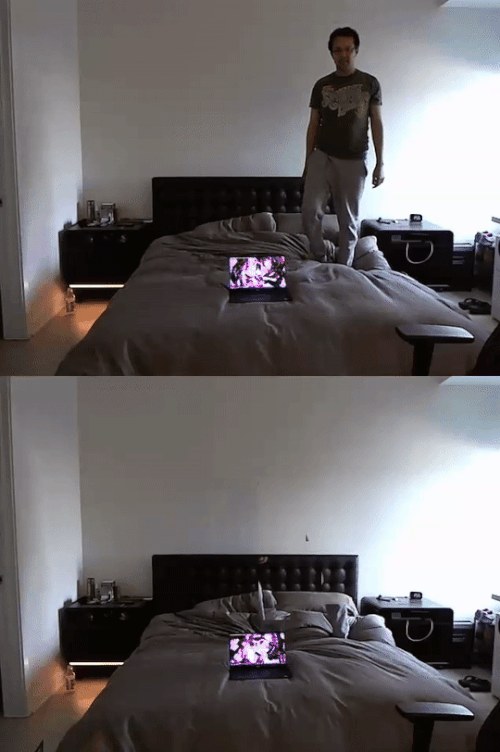
Credit where it is due. Jason Mayes, who works on TensorFlow.js at Google, built Real-Time Person Removal, his "Disappearing People" demo: a browser page that removes people from a live webcam using body segmentation and paints them out with the background it captured of the empty room. That is the same instinct VeBeGe runs on, and he got there first as a public demo.
VeBeGe is not trying to beat ProPainter on a benchmark. It
takes the diminished-reality idea those systems explore and makes it something you
install once and forget: pick the (VeBeGe) camera in your call app,
and anyone who is not you is gone before the frame leaves your machine.